
Spending money on a new commercial door does not always feel urgent, especially when the old one still technically works. But there is a significant difference between a door that functions and a door that performs. If your facility is running outdated or mismatched overhead doors, you may be absorbing costs you have not fully accounted for yet.
Commercial sectional doors are one of those facility investments that pay for themselves over time, not through a single dramatic return, but through consistent, compounding savings. This article breaks down exactly where that value comes from, and why more Richmond, CA, businesses are making the switch.
Lower Energy Bills Month After Month
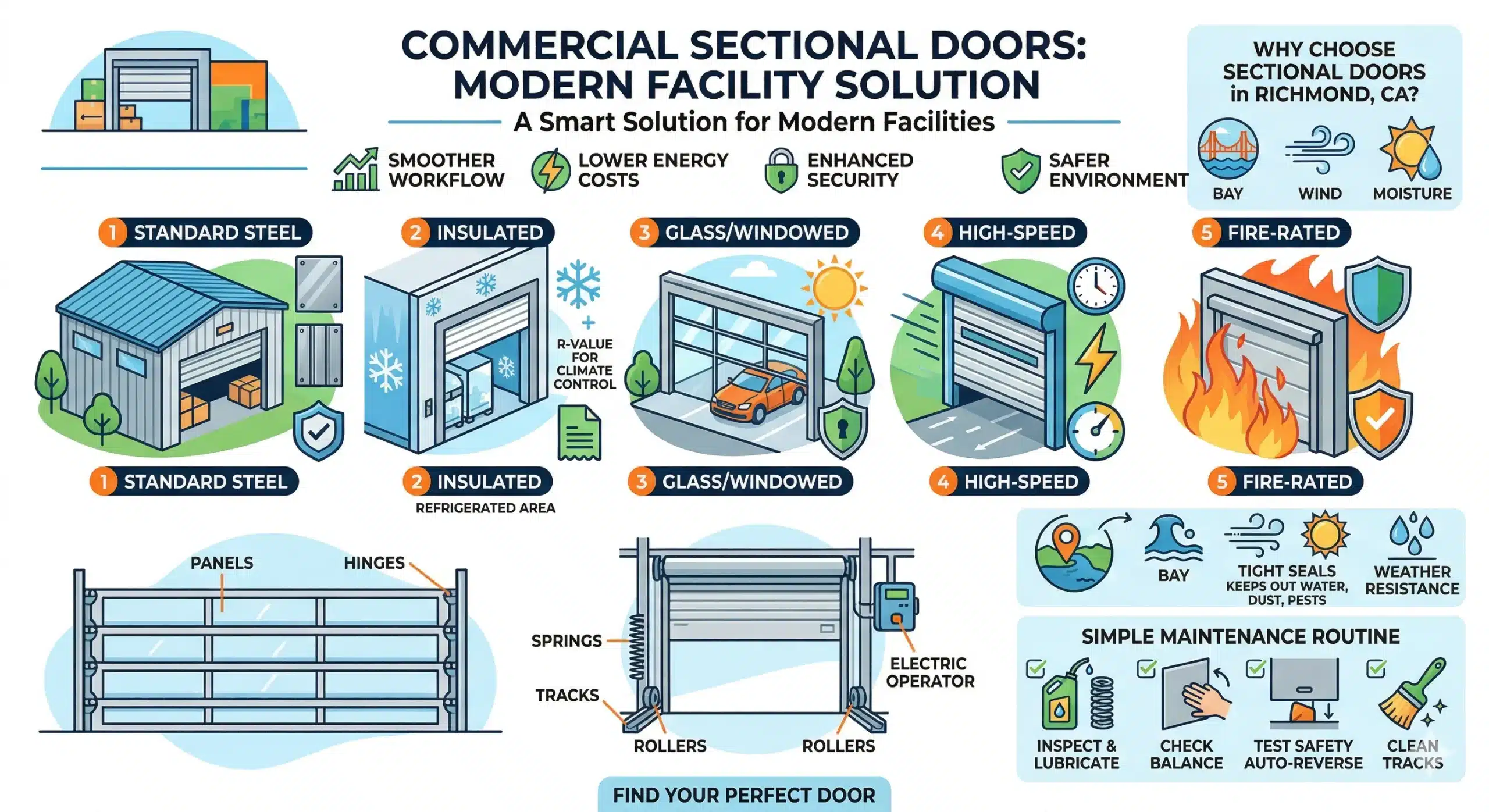
One of the clearest financial benefits of upgrading to a quality commercial sectional door is the reduction in energy costs. Here is what drives those savings.
- Conditioned air stays in. Older doors without proper insulation allow heated or cooled air to escape every time they open, and even when closed, gaps in panels and worn weather seals let outside air infiltrate your facility continuously.
- R-value makes the difference. Insulated commercial sectional doors are rated by R-value, which measures how well they resist heat transfer. A higher R-value keeps heated air inside during winter and blocks outdoor heat during summer, reducing the workload on your HVAC system.
- Richmond, CA, climate adds up. Coastal air, seasonal temperature swings, and marine humidity mean your facility is constantly battling outdoor conditions. A properly insulated door reduces that battle every single day of the year.
- Payback happens faster than most expect. The upfront cost of an insulated door is typically recovered through utility savings within a few years of installation, making it one of the more predictable capital investments a facility manager can make.
To get a full picture of what to look for in an insulated door before purchasing, the article What to Look for When Buying a Commercial Sectional Door covers insulation ratings and selection criteria in detail.
Fewer Emergency Repair Calls
Outdated or worn commercial doors break down more frequently, and every emergency repair call carries both direct and indirect costs. Here is what those costs actually look like.
- Service fees at a premium. Same-day or after-hours emergency repairs cost significantly more than scheduled maintenance visits. The more often your door fails, the more you pay at the worst possible rates.
- Workflow disruption adds up fast. A door that stops working during business hours delays shipments, idles workers, and in some cases halts production entirely. These are costs that never show up on a repair invoice but are very real to your operation.
- Industrial-grade components cycle longer. Commercial sectional doors built to industrial standards use heavier-gauge steel, higher-cycle springs, and commercial-grade operators designed to run tens of thousands of cycles before needing attention.
- Planned maintenance beats reactive repairs. When you can schedule maintenance on your own terms rather than react to an unexpected failure, you spend less overall and avoid the compounding cost of emergency response.
Preventive maintenance strategies align with garage door maintenance best practices, which emphasize routine inspection and servicing to avoid costly emergency breakdowns.
Improved Security That Protects Your Assets
Every facility stores something valuable, whether that is inventory, equipment, vehicles, or sensitive materials. A door that fails to hold the line puts all of it at risk. Here is how commercial sectional doors strengthen your security posture.
- Reinforced steel panels resist forced entry. Commercial sectional doors made from heavy-gauge steel are significantly more difficult to breach than lighter-duty alternatives used in lower-cost options.
- Commercial-grade locking hardware adds another layer. When combined with proper locking systems, a quality sectional door becomes a substantial deterrent against unauthorized entry.
- Passive security reduces theft of opportunity. A malfunctioning or poorly sealed door creates an easy opening for someone passing by. A well-maintained sectional door eliminates that vulnerability.
- Reduced liability exposure. A secure door lowers your exposure to theft-related losses, insurance claims, and the legal liability that can follow a security breach at your facility.
Security performance is also influenced by material strength and design, as outlined in garage door security and material considerations, which highlight the importance of reinforced construction for commercial applications.
Faster Operations and Less Downtime
For facilities where vehicles, forklifts, or delivery trucks move in and out frequently, door performance directly affects productivity. Here is where the operational value shows up.
- Every second at the door adds up. A slow or frequently jammed door creates a bottleneck that compounds across dozens of daily cycles. Over a week, those delays translate into measurable lost time.
- High-speed models reduce cycle time significantly. Modern commercial sectional doors, especially high-speed variants, are engineered to open and close quickly without compromising on sealing or structural integrity.
- Downtime carries a hidden cost. When a door goes down mid-operation, the cost is not just the repair. It is every delayed truck, every idle worker, and every frustrated customer waiting on a shipment that did not go out on time.
- Reliability removes a variable from your operation. For logistics centers, manufacturing plants, and auto service facilities in Richmond, CA that run on tight schedules, a dependable door is one less thing that can derail the day.
Better Workplace Safety for Your Team
A malfunctioning commercial door is a safety hazard. Springs under high tension, frayed cables, misaligned tracks, and outdated auto-reverse systems create real risks for the people working near them every shift. Here is what modern commercial sectional doors do differently.
- Auto-reverse sensors stop the door before contact. Required by current safety standards, these sensors detect an obstruction in the door’s path and reverse before impact, protecting workers, equipment, and vehicles.
- Safety cables contain spring failures. If a spring snaps under tension, safety cables prevent it from whipping across the room. This is a feature that older doors often lack entirely.
- Pinch-resistant panel design protects hands. Panels designed to prevent fingers from being caught between sections during operation are standard on quality commercial sectional doors.
- The financial case for safety is clear. A preventable injury leads to workers’ compensation claims, potential OSHA investigations, increased insurance premiums, and, most importantly, harm to a member of your team.
If you want to know why commercial sectional doors are ideal for today’s properties, read Commercial Sectional Doors: A Smart Solution for Modern Facilities.
Long Service Life That Justifies the Upfront Cost
A quality commercial sectional door does not need to be replaced every few years. Here is why the service life math works strongly in its favor.
- 15 to 30 years of reliable service. A properly installed and maintained commercial sectional door can serve your facility for decades, compared to lower-cost alternatives that may need full replacement in 5 to 10 years.
- Cost per year of service tells the real story. When you spread the purchase price over the door’s full service life, a premium door often comes out significantly ahead of cheaper options that require more frequent replacement.
- Modular design extends the useful life further. Because commercial sectional doors are built in sections, individual panels, springs, and hardware components can be replaced without replacing the entire door. That repairability adds years to an already long service life.
- Easier to plan for in capital budgets. For facility managers responsible for long-term capital planning, a door with a predictable and extended service life is far easier to budget for than one that surprises you with an early failure.
Increased Property and Resale Value
Commercial real estate is evaluated in part by the condition of its infrastructure, and doors are a visible and functional part of that picture. Here is how a door upgrade affects your property’s standing.
- Modern doors improve first impressions. Facilities equipped with well-maintained, modern commercial sectional doors present better to potential buyers or tenants than those with aging or mismatched overhead doors.
- Ownership benefits from the upgrade directly. If your business owns its facility, upgrading the doors is an infrastructure improvement that can positively affect property value at the time of sale or appraisal.
- Leasing situations benefit, too. If you lease your space, a well-functioning door reduces friction with landlords and avoids disputes over deferred maintenance responsibilities.
- Door condition signals overall maintenance standards. The visible condition of your doors is evidence of how well the entire facility has been maintained, which matters to anyone evaluating the property.
The Smart Timing Question: Now or Later?
Some facility managers delay upgrades to sectional or rolling doors because the current system is still operational. Here is why that reasoning often costs more than it saves.
- Cumulative costs are easy to overlook. Every month of energy inefficiency, every emergency repair fee, every near-miss safety incident, and every lost hour of productivity adds to a running total that is rarely tracked as a single line item.
- The question is when, not whether. The real decision is not whether to upgrade. It is whether the cost of waiting has already exceeded the cost of acting.
- Delaying replacement rarely saves money. An aging door that needs a major repair today is likely to need another within a short period. You are paying to extend the life of a door that is already in decline.
- Proactive planning puts you in control. A facility manager who replaces a door on a planned schedule avoids the disruption, premium costs, and lost productivity that come with a sudden failure.
For businesses actively evaluating the condition of their current doors, the article When to Repair or Replace Your Commercial Sectional Door offers a clear framework for making that call.
The Investment That Keeps Returning Value
The case for commercial sectional doors is not built on a single benefit. It is the combination of energy savings, reduced repair costs, improved safety, better security, and longer service life that makes the financial argument compelling.
For facility managers in Richmond, CA who are running operations that depend on reliable infrastructure, this is an upgrade that pays for itself in ways both direct and indirect. Taking a disciplined, data-informed approach to your door decision is the kind of management that protects your bottom line year after year.
R&S Erection of Richmond Inc has extensive experience helping commercial and industrial facilities evaluate, select, and install the right sectional doors for their specific operations. Contact us today or give us a call to discuss what the right investment looks like for your facility.