
Every commercial sectional door has a lifespan. The challenge for facility managers is knowing when a repair will genuinely extend that life and when it is simply postponing the inevitable at a growing expense. Getting this decision wrong in either direction costs money: replacing too early wastes capital, while delaying too long compounds maintenance costs and operational risks.
This guide gives you a structured way to evaluate the condition of your current door and make the right call for your facility. The signs covered here are based on real-world patterns seen in commercial and industrial door systems, and they apply across warehouses, loading docks, manufacturing facilities, and auto service centers throughout Richmond, CA.
Recognize the Difference Between Normal Wear and Structural Decline
Not every problem with a sectional or rolling door signals the end of the door’s life. Some issues are routine, expected, and inexpensive to address. Others are warning signs that the door’s structural integrity or core components have reached a point where continued repair is no longer the smart financial choice.
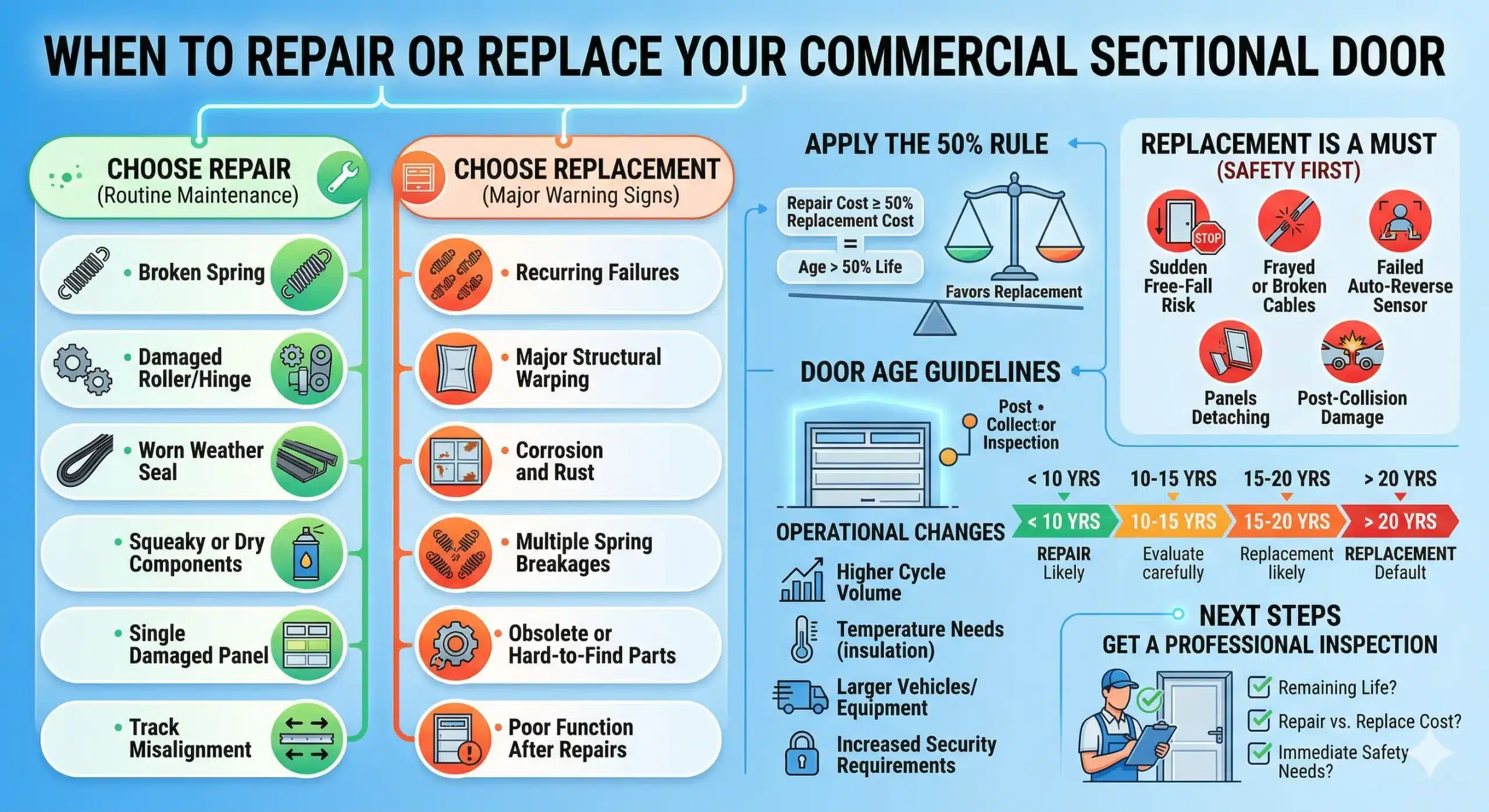
Repairs that make sense:
- Replacing worn rollers or hinges
- Lubricating dry or squeaky components
- Replacing a damaged weather seal
- Fixing a misaligned track
- Replacing a single damaged panel
- Swapping out a worn-out spring on an otherwise sound door
Signs that replacement may be the better option:
- Multiple major components are failing within a short period
- Frequent panel damage from structural fatigue rather than isolated incidents
- A door that has been repaired repeatedly and still cannot maintain consistent operation
- Springs or cables that have been replaced multiple times on an aging door
- Structural warping, bowing, or twisting that cannot be corrected
Understanding this difference is the starting point for every repair versus replacement decision.
For facilities evaluating whether a safer, more reliable door is the answer, the article Why Commercial Sectional Doors Are Worth the Investment outlines how a modern door investment reduces long-term safety risk and related costs.
Watch for These Specific Warning Signs
Certain problems, when they appear together or in combination with an aging door, should prompt a serious evaluation rather than a quick repair order.
- Uneven movement: If the door rises or lowers on one side faster than the other, the spring tension is unbalanced, or a cable has stretched or snapped on one side. This puts stress on the entire panel assembly.
- Persistent grinding or scraping sounds: This can indicate that rollers have deteriorated to the point where they are no longer rolling, the tracks are damaged, or panels are no longer aligned properly with the track system.
- Door reverses before fully closing: This is sometimes a sensor issue, but it can also indicate that the panels have warped or the track has shifted, so the door physically cannot complete its travel without triggering the safety reversal system.
- Visible rust or corrosion on panels: Surface rust can sometimes be treated. But when corrosion has spread through the panel material and begun to affect structural integrity, the affected sections or the entire door need replacement.
- Bottom seal that no longer contacts the floor evenly: A gap at the bottom creates drafts, water intrusion, and pest entry. If the cause is a warped bottom panel or an unlevel door that cannot be corrected with hardware adjustments, replacement of that section or the full door may be necessary.
- Operator running but door not moving: This can be a sign of a broken cable or a spring failure severe enough that the operator cannot overcome the door’s weight. In older doors, this failure pattern sometimes repeats after repair.
The article Commercial Sectional Doors: A Smart Solution for Modern Facilities provides background on the core components involved, which helps in understanding why these failure points develop.
Apply the Rule of Escalating Repair Costs
A useful framework for this decision is what facility managers sometimes call the escalating repair cost rule. If the cost of a repair equals or exceeds 50 percent of the cost of replacement, and the door is more than halfway through its expected service life, replacement is almost always the more economical choice.
Here is why. A door near the end of its life that needs a major repair today is likely to need another significant repair within a short period. You are essentially paying to extend the life of a door that is already in decline. Each successive repair buys less reliability.
Compare this to investing in a new door with a full service life ahead of it, updated safety features, and a manufacturer’s warranty. Spread over 15 to 25 years, the math usually favors replacement.
This framework does not replace professional assessment, but it gives facility managers a starting point for the conversation with their service provider.
Beyond cost considerations, adherence to automatic garage door safety standards and compliance reinforces the importance of upgrading systems that no longer meet current operational and safety expectations.
Know When Safety Mandates Replacement
Some door conditions are not a judgment call. They are safety failures that require immediate action, regardless of the door’s age or the cost of replacement.
- Broken torsion spring on a door without safety cables: A broken spring can cause the door to free-fall. This is a serious injury risk for anyone nearby.
- Frayed or broken cables: Cables that support the door’s weight are under tremendous tension. A failed cable can cause the door to drop suddenly or operate asymmetrically in a way that stresses the entire system.
- Non-functioning auto-reverse sensor: A commercial door operator is required by safety standards to include entrapment protection. A door whose auto-reverse system cannot be restored to proper function must be taken out of service until repaired or replaced.
- Panels separating from the track system: If panels have detached from the roller and track system, the door becomes unstable. Operating it in this condition is dangerous.
- Significant structural deformation: A door that has been struck by a vehicle or suffered impact damage may appear functional while actually being compromised at the structural level. Always have a professional inspect any door that has sustained a significant impact.
Industry safety organizations emphasize the importance of properly functioning door systems, and garage door safety tips and standards highlight critical risks associated with failing components and improper operation.
Assess Your Door’s Age Against Its Expected Service Life
Age alone does not determine when a door needs replacement, but it is a critical variable in the decision.
A well-maintained commercial sectional door can last 15 to 30 years. However, the key components that drive daily operation, particularly springs and rollers, have shorter lifespans. Springs are typically rated for a set number of cycles. When a door has required two or more spring replacements, it is approaching the point where other major components are also nearing the end of their life.
Use this general framework when evaluating an aging door.
- Under 10 years old: Most problems are candidates for repair. A door in this age range should have significant service life remaining.
- 10 to 15 years old: Evaluate each repair carefully. If major components like springs, cables, or the operator need replacement, factor in the remaining expected service life of the door.
- 15 to 20 years old: This is the zone where replacement is increasingly likely to be the better financial decision, especially if the door requires a significant repair.
- Over 20 years old: Replacement should be the default consideration. Repairs at this stage typically involve parts that are harder to source and may not restore the door to reliable performance.
These are guidelines, not rules. A 22-year-old door that has been exceptionally well-maintained and needs only a minor roller replacement may still have years of service left. Context always matters.
Factor in Changes to Your Operational Requirements
Sometimes the question is not whether the door is failing but whether it still fits the job it needs to do.
Facilities evolve. Operational demands change. A door that was adequate for the original use of your space may no longer meet your current requirements.
Consider replacement when any of the following applies.
- Your facility now needs a higher cycle volume than the current door was designed for.
- You have added temperature-controlled operations that require a more insulated door.
- Vehicle or equipment size has increased, and the existing opening is now too small.
- Security requirements have increased, and the current door no longer meets the standard.
- Your facility is expanding or reconfiguring, and the door’s location no longer works for the updated layout.
In these cases, replacing the door is not about failure. It is about right-sizing your facility infrastructure to match where your business is today.
What to Do When You Are Unsure
If you are not certain whether your door needs repair or replacement, the most reliable next step is a professional inspection by a qualified commercial door technician. A trained technician can assess the condition of your panels, track system, spring assembly, cables, and operator, and give you a documented evaluation of the door’s current state.
During that inspection, ask specifically about the following.
- The estimated remaining service life of the current door.
- Whether the identified repairs will restore the door to reliable function or simply delay further issues.
- The cost comparison between completing the recommended repairs and installing a replacement.
- Any safety concerns that require immediate attention before the door can continue to be used.
Having this information in writing gives you the basis for a clear-headed decision rather than a reactive one.
If your team is also preparing for a future door purchase, the article What to Look for When Buying a Commercial Sectional Door walks through every specification and feature to evaluate before committing to a replacement.
Avoiding the Most Common Mistakes in This Decision
Facility managers commonly make one of two mistakes when evaluating an aging commercial door.
Mistake 1: Repairing too long out of habit. Once a door enters a pattern of recurring repairs, it is easy to authorize the next fix without stepping back to look at the total cost of the last few years of maintenance. Add up what you have spent on repairs over the past three years. If it approaches or exceeds the cost of a new door, you have likely been delaying the inevitable.
Mistake 2: Replacing before exploring targeted repairs. On the other side, a door with a single significant failure may still have many years of reliable service left if the right repair is done correctly. Do not assume that one expensive repair means replacement is necessary.
The right decision is always based on a clear-eyed look at the data: the door’s age, its repair history, the cost of the current issue, and the remaining expected service life.
Knowing the Right Time Makes All the Difference
The repair or replacement decision is one of the most consequential maintenance calls a facility manager makes. Getting it right means your facility operates reliably, your team stays safe, and your maintenance budget stays predictable.
For businesses in Richmond, CA, making this decision with accurate information and professional guidance is the difference between a smart facilities strategy and a reactive one that costs more over time.
R&S Erection of Richmond Inc has helped commercial and industrial facilities throughout the region evaluate their overhead doors and make the right call. Whether your facility needs a targeted repair or a full replacement, Contact us today or give us a call, and we will help you find the most reliable and cost-effective path forward.