
Buying a commercial sectional door is not the same as buying a residential garage door. The stakes are higher, the options are more technical, and the wrong choice can create operational problems that last for years. Whether you are equipping a new facility or replacing an aging door at an existing site, understanding what to evaluate before you buy will save you time, money, and frustration.
This guide is built for facility managers, business owners, and operations leaders who need a clear, practical checklist to use during the purchasing process.
Start With the Right Measurements
Before any other conversation about features, style, or pricing, you need accurate measurements. A commercial sectional door that does not fit your opening correctly is a problem that no amount of quality components can fix.
Here is what to measure and confirm before contacting a supplier.
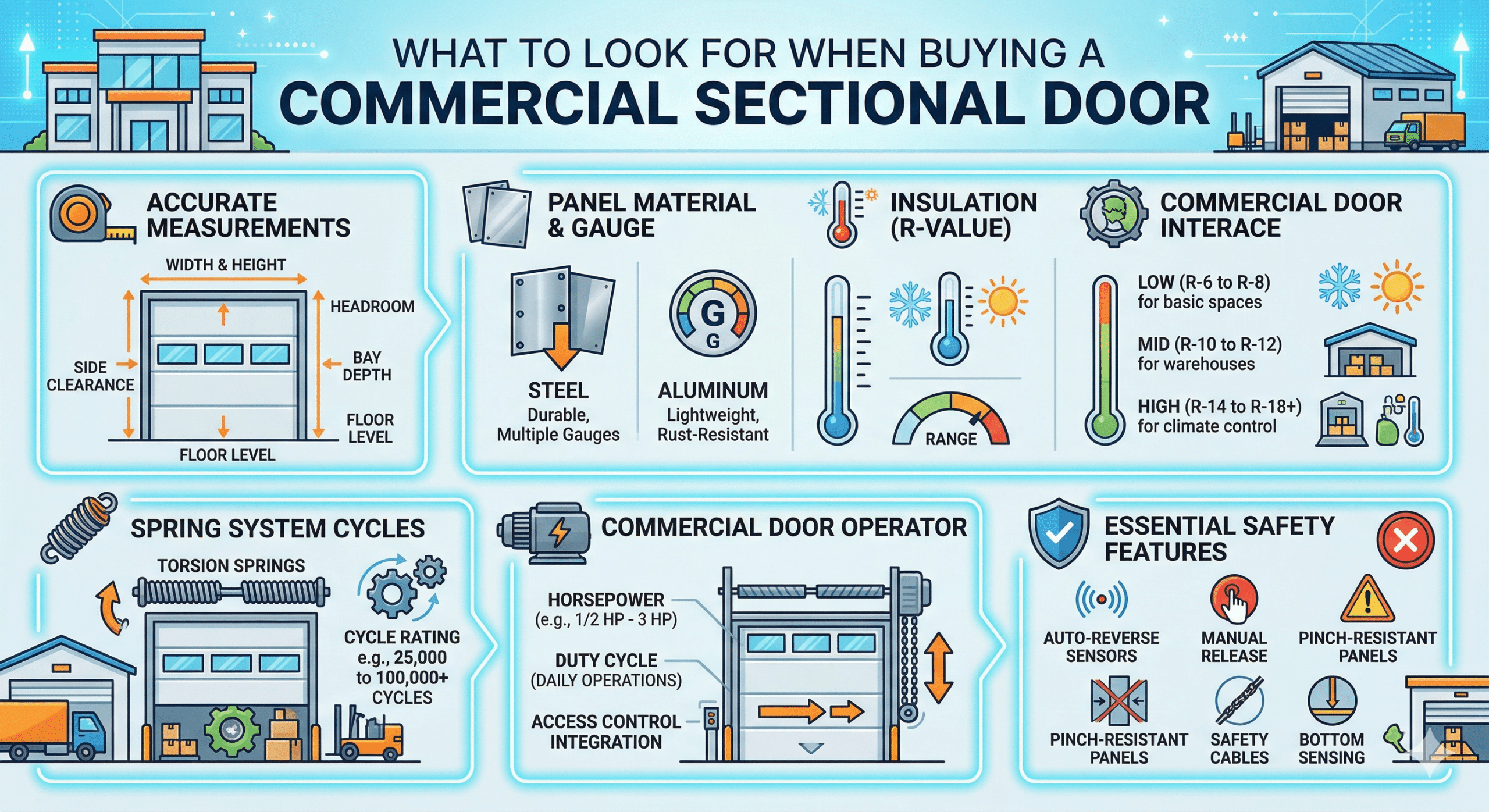
- Clear opening width and height: Measure the actual opening, not the rough framing. This is the usable space your door must cover.
- Headroom: The distance from the top of the opening to the lowest ceiling obstruction above it. Standard sectional door tracks require approximately 10 to 12 inches. If you have limited headroom, low-headroom hardware is available, but it must be specified upfront.
- Side clearance: The space on each side of the opening for the vertical tracks. Typically, two to three inches per side is the minimum.
- Depth of garage or bay: There should be enough room behind the door for vehicles or equipment to clear safely before the door starts closing.
- Floor levelness: If your floor is uneven at the threshold, the bottom seal will not contact evenly, creating a gap. This may require a specialized bottom bar or threshold adjustment.
Bring these numbers to every supplier conversation. A professional installer will want to verify them on-site before finalizing the order.
If you are still working through whether an upgrade makes financial sense, the article Why Commercial Sectional Doors Are Worth the Investment covers the business case in full.
Choose the Right Panel Material and Gauge
The material and gauge of your sectional door panels or rolling door slats directly affect durability, security, insulation capacity, and long-term maintenance needs.
- Steel panels: The standard for commercial and industrial use. Available in multiple gauges. Lower gauge numbers indicate thicker, stronger steel. A 24-gauge panel is heavier and more dent-resistant than a 28-gauge panel. For high-traffic industrial settings, 24-gauge or thicker is the right call.
- Aluminum panels: Lighter than steel and resistant to corrosion. A good option for coastal environments like Richmond, CA, where salt air can accelerate rust on untreated steel. However, aluminum dents more easily.
- Fiberglass or composite panels: Less common in industrial settings, but useful where moisture resistance and lightweight construction are priorities.
For most commercial facilities, galvanized or painted steel with appropriate rust protection is the most cost-effective and durable choice. Ask your supplier about the finish options and what warranty coverage applies to the coating.
To understand how modern facilities benefit from sectional doors, read Commercial Sectional Doors: A Smart Solution for Modern Facilities.
Evaluate Insulation Options by R-Value
If your facility maintains any level of temperature control, insulation is not optional. Selecting a door with inadequate insulation for your climate control needs costs money every month in energy waste.
Commercial sectional doors are assigned an R-value that measures thermal resistance. Here is a simplified guide to matching R-value to your facility’s needs.
- R-6 to R-8: Low-insulation range. Suitable for unheated or minimally conditioned spaces like equipment storage or open loading areas.
- R-10 to R-12: Mid-range insulation. Works for warehouses with moderate temperature control or facilities where the door is a secondary barrier.
- R-14 to R-18+: High-insulation range. Required for refrigerated storage, climate-controlled manufacturing, or facilities where tight temperature control is critical.
Do not rely on the door’s insulation alone. The surrounding frame, weather seals, and threshold all contribute to the complete thermal envelope. A high-R-value door installed with gaps in the perimeter sealing will underperform.
Assess the Spring System for Your Cycle Volume
Springs are one of the most critical components in any sectional door system, and they are the component most likely to need replacement during the door’s life. Choosing the right spring type and cycle rating for your operation prevents unexpected failures.
- Torsion springs: Mounted horizontally above the door opening. These are the standards for commercial sectional doors and offer better balance, smoother operation, and longer life than extension springs. Most commercial doors use torsion springs.
- Extension springs: Run along the side tracks and stretch when the door opens. Less common in commercial settings, but used where torsion spring mounting space is unavailable.
- Cycle rating: Commercial torsion springs are rated by the number of cycles they can complete before failure. Standard commercial springs may be rated at 25,000 cycles. High-cycle springs used in heavy-traffic facilities can be rated at 100,000 cycles or more. Know your daily cycle volume and choose springs rated accordingly.
Spring replacement is one of the most common commercial door repairs. Specifying high-cycle springs upfront can significantly extend the interval between service calls.
Select the Right Commercial Door Operator
The operator, also called the opener, is what drives the door up and down. Commercial door operators are different from residential units in power, duty rating, and durability.
Key factors to evaluate include the following.
- Horsepower: Commercial operators are typically rated between 1/2 HP and 3 HP, depending on the door size and weight. Undersizing the operator causes premature wear. Ask your installer to specify the correct HP for your door.
- Duty cycle: Operators are rated for a certain number of daily operations before overheating or wearing out. A duty cycle of 25 operations per day is standard. Facilities with higher traffic need a heavier-duty operator.
- Drive type: Chain drive, belt drive, or direct drive. Chain drives are durable and cost-effective. Belt drives are quieter. Direct drive units are compact and low-maintenance.
- Control integration: Consider whether you need the operator to integrate with access control systems, keypads, remote entry, or facility management software.
Understanding operator differences is essential, and guides on garage door opener types and performance outline how drive systems and configurations impact reliability and efficiency.
Check Safety Features Before Signing Off
Any commercial door you purchase should meet current safety standards without exception. Do not treat safety features as optional upgrades.
Required safety features to confirm include the following.
- Auto-reverse entrapment protection: Sensors that detect obstructions and reverse the door before contact. Required by UL 325 standards for all commercial operators.
- Manual release: Allows manual operation during power failures. Essential for any facility where personnel could be trapped.
- Pinch-resistant panels: Panel design that prevents fingers from being caught between sections during operation.
- Safety cables: Secondary cables threaded through extension springs to prevent a dangerous spring snap-back if the spring breaks.
- Bottom bar and sensing edge: A bottom bar with a rubber sensing edge that reverses the door if it contacts an obstruction at floor level.
Ask your supplier to provide documentation confirming compliance with applicable safety standards and any local code requirements for commercial door installations in Richmond, CA.
Look at Wind Load and Structural Ratings
Commercial facilities, especially those near the coast or in exposed locations, should pay attention to wind load ratings. A door that is not rated for the wind pressures common to your area can fail structurally during storms.
Wind load ratings indicate the maximum wind pressure the door can withstand while remaining functional and intact. Your local building department or installer can advise on the wind load requirements specific to your location in Richmond, CA.
Doors in wind-sensitive locations may also benefit from horizontal reinforcement struts or additional track bracing. These are typically available as options from your supplier and should be factored into the specification if needed.
The article When to Repair or Replace Your Commercial Sectional Door also addresses structural damage as a key signal that a door needs replacement rather than repair, which is useful context when wind damage is a concern.
Ask the Right Questions Before You Commit
A buying decision of this scale deserves thorough due diligence. Before signing any purchase or installation agreement, ask your supplier or installer the following questions.
- What warranty is provided on panels, springs, and the operator? What does it cover?
- Is the installer licensed and insured for commercial door installation in California?
- How long does installation typically take, and what access to the facility is required?
- What maintenance does the door require, and is a service agreement available?
- Will the installation include a full safety inspection and test before the crew leaves?
These questions separate reliable installers from those who may cut corners on specification, installation quality, or post-sale support.
Buying Right the First Time Saves You Later
Purchasing a commercial sectional door is a long-term decision. A well-specified, properly installed door runs reliably for 15 to 30 years with the right maintenance. A poorly specified door, even if the upfront cost was lower, creates years of operational friction and unexpected expense.
For Richmond, CA facility managers, taking the time to work through these evaluation points before purchasing is the difference between a door that earns its cost and one that adds to it.
R&S Erection of Richmond Inc specializes in helping commercial and industrial clients navigate exactly these decisions. From measurement and specification to installation and after-sales support, our team is ready to make sure your facility gets the right door. Contact us today or give us a call to schedule your consultation.